Choosing a reliable 2K overmolding service supplier involves more than finding a manufacturer capable of injecting two materials into one component. The success of a multi-material part depends on material compatibility, mold design, injection sequence, interface bonding, and dimensional stability. For product developers, these factors determine whether a combination of rigid structural plastic and soft-touch material can deliver the required functionality, appearance, and production consistency.
At SHD, we support custom injection molding and 2K overmolding projects, helping customers evaluate material combinations, tooling requirements, and manufacturing feasibility before production.
What Does a 2K Overmolding Service Supplier Actually Provide?
A 2K (two-component) molding process combines two materials or colors within a coordinated injection molding operation. The first material forms the initial substrate, while the second is injected into designated areas to create an integrated component.
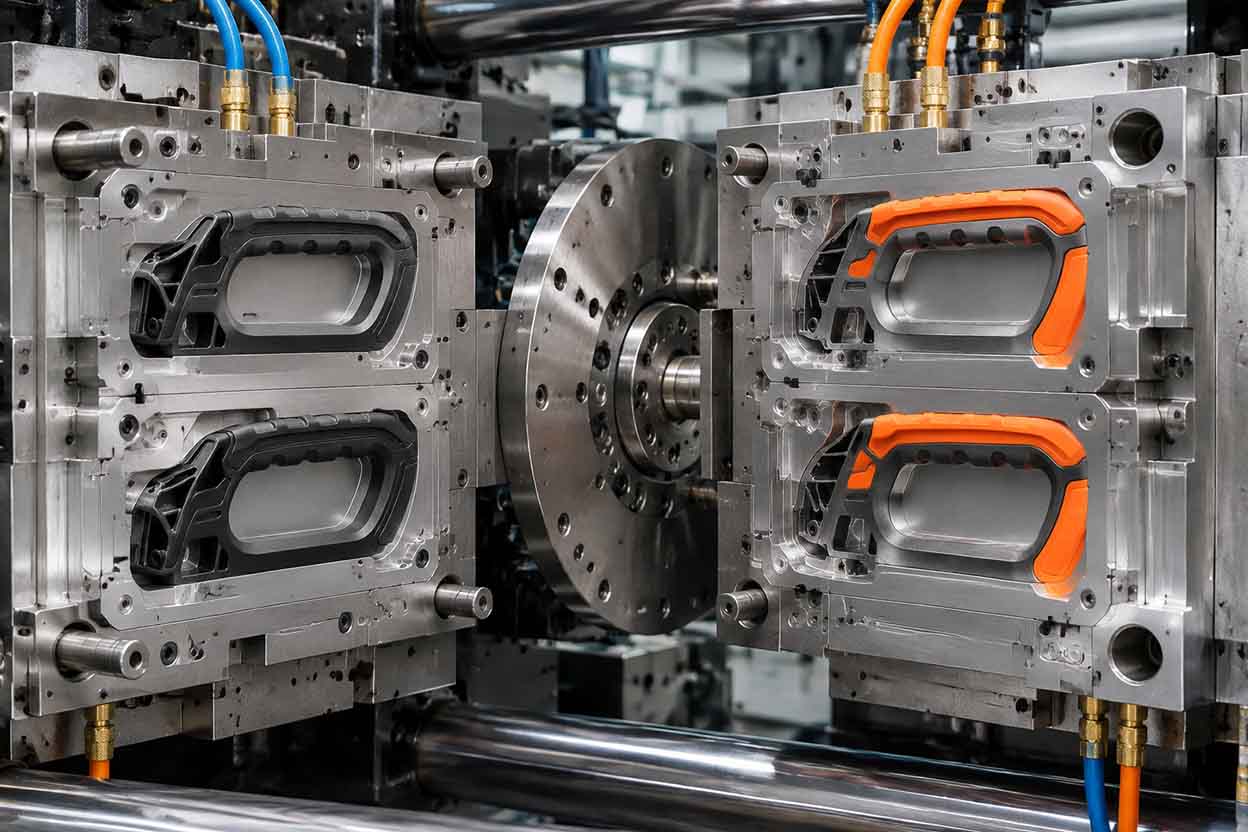
Unlike conventional single-material molding, this process allows different sections of one product to perform different functions. A rigid plastic structure can provide mechanical support, while a softer material adds grip, cushioning, sealing, or tactile comfort.
A qualified 2K overmolding service supplier should therefore evaluate the complete component rather than treating the two materials as separate molding orders. Typical applications include:
- Power tool handles with rigid internal structures and soft grips.
- Electronic device housings with flexible buttons or protective sections.
- Automotive interior components with integrated soft-touch surfaces.
- Industrial knobs, switches, and control interfaces.
- Consumer product handles and ergonomic contact surfaces.
2K Molding vs. Insert Molding: Understanding the Process Difference
Although these manufacturing methods can produce multi-material components, their tooling and production arrangements are different.
Two-shot injection molding
In a conventional two-shot process, two injection units deliver different materials into a coordinated mold system. The first shot forms the substrate, which is then transferred, rotated, or repositioned for the second injection. Both shots are integrated into the production cycle.
Insert molding and sequential overmolding
In insert molding or sequential overmolding, a previously molded substrate is placed into another mold before the second material is injected. This can involve separate molding operations and additional handling.
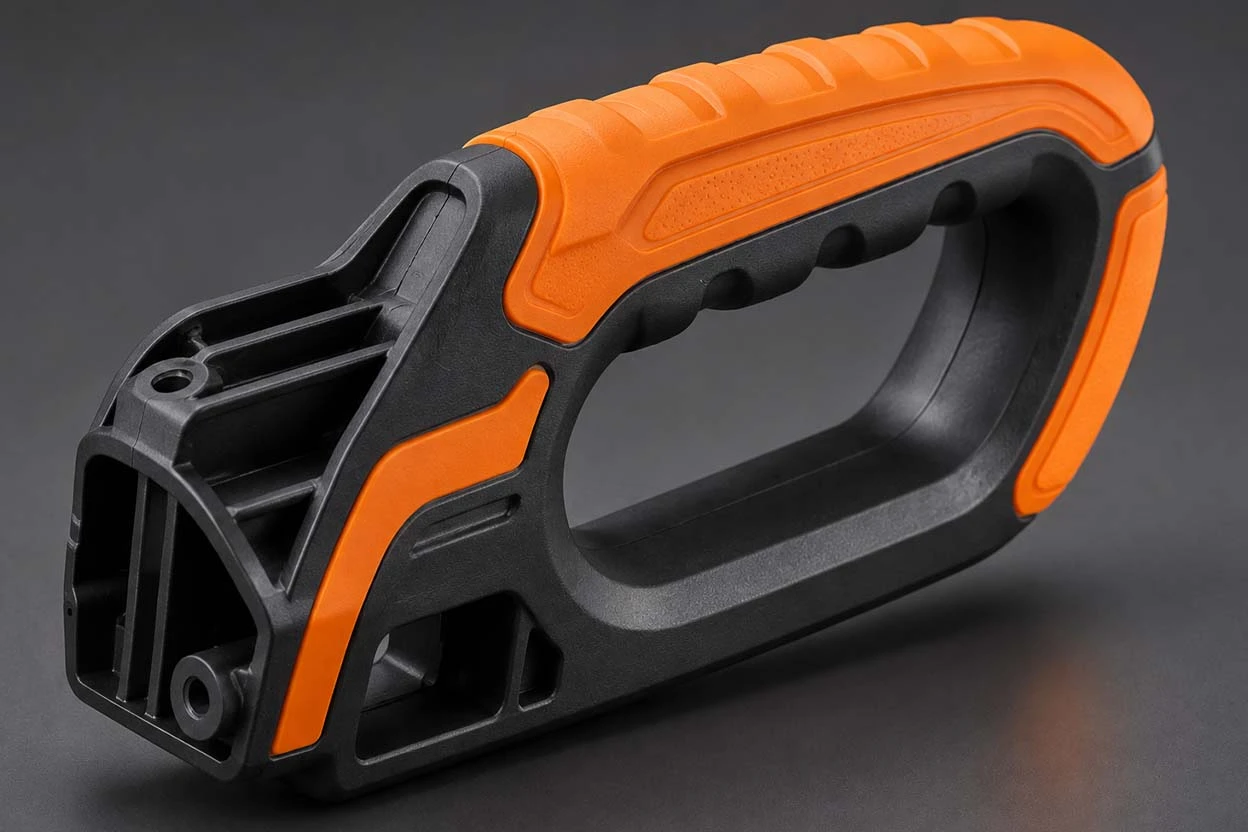
The choice depends on product geometry, production volume, available equipment, material requirements, and tooling investment. For example, a high-volume ergonomic handle may benefit from an integrated two-shot process, while a component requiring a separately manufactured substrate may be better suited to insert molding.
Material Compatibility: The Foundation of Reliable Bonding
One of the most important considerations in plastic overmolding is the interaction between the two selected materials.
A material combination should not be approved simply because both materials belong to commonly used thermoplastic families. Their specific commercial grades, additives, processing temperatures, and surface characteristics can influence bonding performance.
Common material combinations considered during project development include:
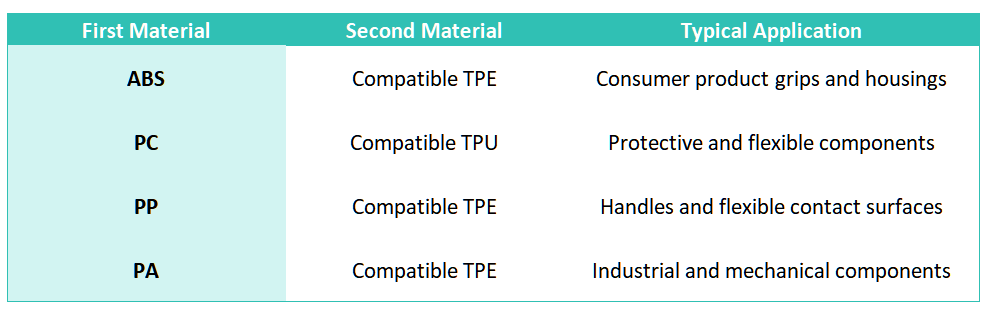
These are potential material pairings, not universal compatibility guarantees. The exact grades must be reviewed with material suppliers and validated through molding trials.
If chemical adhesion is insufficient, mechanical interlocking features such as grooves, undercuts, and through-holes may help retain the second material. Their suitability depends on the loading direction and product geometry.
How Mold Design Influences 2K Product Quality
A successful two-shot project requires both material systems to be considered during the initial tooling design. Several engineering factors deserve attention:
1. First-shot positioning
The initial substrate must remain accurately positioned during the second injection. Rotation, transfer, and locating mechanisms should prevent displacement that could affect material coverage.
2. Interface geometry
The contact area between the two materials should be designed according to the required bonding and mechanical loading conditions. Sharp transitions, insufficient contact areas, or poorly supported edges can create weak points.
3. Wall thickness and shrinkage
Different materials may cool and shrink at different rates. Uneven wall thickness and incompatible shrinkage behavior can contribute to warpage, sink marks, or dimensional variation.
4. Gate location and material flow
The gate positions and flow paths should allow the second material to fill the intended regions without producing unacceptable weld lines, trapped air, or visible surface defects.
5. Flash control and shut-off design
The mold must maintain reliable contact at the material boundary. Poor shut-off conditions can allow the second material to enter unwanted areas, affecting appearance and assembly dimensions.
These considerations should be reviewed through design-for-manufacturing evaluation before mold fabrication begins.
Quality Inspection for Multi-Material Injection Molded Parts
Finished components require more than a visual inspection of the two material colors. A practical quality plan should evaluate:
-Bonding performance: Whether the material interface withstands the intended separation, peel, or loading conditions.
-Dimensional accuracy: Whether the first and second molding stages maintain the required component geometry.
-Surface appearance: Whether flash, sink marks, color transitions, and surface imperfections meet approved specifications.
-Functional performance: Whether soft sections provide the intended grip, flexibility, cushioning, or sealing.
-Production repeatability: Whether the approved material combination and molding conditions can be maintained across production batches.
Inspection methods should be selected according to the product's actual operating conditions. For example, a soft grip and a sealing lip require different functional acceptance criteria. Sample approval should establish the reference for material hardness, color, interface appearance, dimensions, and functional requirements before production release.
Working with SHD on Custom 2K Overmolding Projects
As a 2K overmolding service supplier, SHD provides injection molding and tooling support for customers developing components that combine different materials or colors.
Our manufacturing services include plastic mold development, injection molding, and 2K overmolding. Project evaluation can cover part geometry, proposed resin grades, interface requirements, mold structure, and production expectations.
For an initial technical review, customers can provide:
-3D CAD models and 2D engineering drawings.
-Proposed first-shot and second-shot materials.
-Required hardness, color, and surface finish.
-Functional requirements, including grip, sealing, and impact resistance.
-Estimated production quantity and development schedule.
SHD can review these requirements to assess manufacturing feasibility and the appropriate tooling approach. Sample verification helps establish the final material combination, dimensional specifications, and appearance standards before production.
Whether you are developing an ergonomic handle, a multi-material electronic enclosure, or a custom industrial component, early coordination between product design, material selection, and mold engineering helps reduce development risks and establish a more reliable manufacturing process.