Silicone mold vacuum casting offers a practical way to produce small batches of plastic components without investing immediately in steel injection molds. Imagine an engineer approving a beautifully finished prototype housing, only to discover that later copies show slight dimensional changes or visible surface differences. The first part looked right. So what changed?
This is where the quality of the master pattern, silicone mold condition, casting material, and inspection plan becomes important. For product development teams, successful replication is not simply about producing one attractive sample. It is about maintaining acceptable results throughout the required batch.
How Silicone Mold Vacuum Casting Affects Small-Batch Consistency
Everything Begins with the Master Pattern
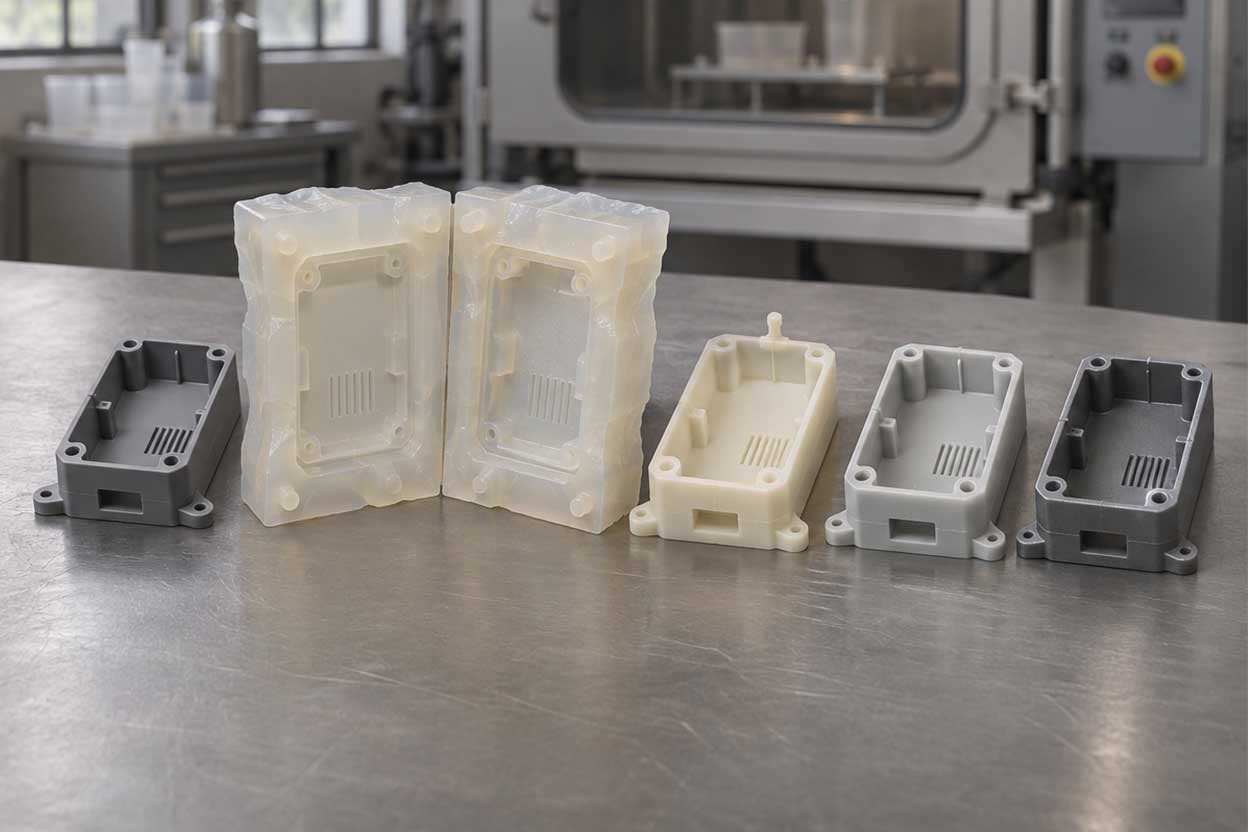
The process usually begins with a master pattern produced through CNC machining or 3D printing. A silicone mold is created around this master, capturing its geometry and surface details. Once the mold is prepared, liquid casting resin, commonly polyurethane, is introduced under controlled vacuum conditions and subsequently cured. Here is the interesting part: the silicone mold does not distinguish between a carefully designed texture and an unwanted scratch.
Both can be reproduced. For this reason, master preparation is critical. Visible surfaces, edges, small features, and dimensional requirements should be reviewed before the silicone mold is made. When producing vacuum casting prototypes, the master pattern effectively establishes the visual reference for subsequent parts.
Why the Mold Cannot Be Ignored After the First Casting
Silicone molds are flexible, making it possible to reproduce certain complex geometries and undercuts that would require more complicated hard tooling. However, flexibility does not mean unlimited durability.
Repeated demolding, material exposure, and handling can gradually affect mold condition. Depending on the geometry and resin, edges may deteriorate, parting lines may become more noticeable, and dimensional consistency can change. The design of silicone mold tooling should therefore consider parting-line placement, pouring channels, venting, and the expected number of castings.
For larger orders, multiple silicone molds may be required. This introduces another consideration: parts produced from different molds should still satisfy the same approved requirements.
Material Selection and Inspection Must Work Together
Vacuum-cast polyurethane materials can reproduce certain characteristics of conventional engineering plastics, but they are not automatically equivalent to injection-molded ABS, PC, or PP.
Material selection should follow the intended application.
A cosmetic enclosure may prioritize appearance, color, and surface texture. A functional prototype may require particular hardness, mechanical behavior, or assembly performance. Before small-batch production, buyers should confirm the proposed resin, required quantity, critical dimensions, surface finish, and expected operating conditions.
A first-off sample can establish an agreed reference, while subsequent inspection should focus on functional features and visible quality. This helps distinguish acceptable manufacturing variation from defects that could affect assembly or product evaluation.
Conclusion
Silicone mold vacuum casting is especially useful when a project requires more than one prototype but is not yet ready for injection molding. Its value comes from combining an accurate master pattern, suitable casting materials, controlled mold preparation, and clearly defined acceptance requirements.
For buyers, approving the first sample is only the beginning. Consistency across the remaining batch is what makes the process valuable.
Prototype Development with SHD
SHD supports custom prototype manufacturing discussions based on customer drawings, material requirements, functional features, and expected production quantities.
For projects considering silicone mold vacuum casting, early evaluation of master quality, mold design, material selection, and inspection expectations can help determine a practical small-batch manufacturing approach.
Share your design requirements with SHD to discuss suitable prototyping and production options.