
-
Phone
+86 139 2658 4851
-
Address
902, Building A3, Tianrui Industrial Park, No. 35 Fuyuan 1st Road, Zhancheng Community, Fuhai Street, Bao'an District, Shenzhen
-
E-mail
Digital Manufacturing for Automotive Product Development
Conquer ever-shortening development cycles for traditional, electric, and autonomous vehicles with rapid prototyping and low-volume production
The automotive industry is evolving fast. As industry trends like autonomous driving, on-board connectivity, and hybrid/electric vehicles continue to drive innovation, agility-minded automotive companies are turning to SHD to accelerate new product development and get to market faster. With quick-turn digital manufacturing and automated manufacturability feedback, designers and engineers can mitigate design and cost risks while developing a more responsive supply chain to better react to driver and passenger demand for more customized vehicles.
Why SHD for Automotive Development?
Rapid Prototyping
Mitigate design risk through rapid iteration and prototyping in production materials without sacrificing development speed.
Supply Chain Flexibility
Get on-demand support for line-down emergencies, part recalls, or other supply chain disturbances in your production plants by using automated quoting, rapid tooling, and low-volume production parts.
Quality Inspections
Validate part geometry with several quality documentation options. Digital inspection, PPAP, and FAI reporting are available.
Tooling and Fixtures
Improve manufacturing processes to create greater automation and streamlined component assembly with custom fixturing.
Mass Customization
Implement low-volume manufacturing to enable more diverse and customized automotive features that are tailored to modern drivers.
What Materials Work Best for Automotive Applications?

Thermoplastics. Choose from hundreds of thermoplasticsincluding PEEK, acetal, or supply your own material. Maintain branding with custom colorant for qualified projects.

Nylons. 3D print functional prototypes in several nylon materials available through selective laser sintering and Multi Jet Fusion. Mineral- and glass-filled nylons improve mechanical properties when needed.

Liquid Silicone Rubber. Silicone rubber materials such as fuel-resistant fluorosilicone can be used for gaskets, seals, and tubing. An optical clarity silicone rubber is also available for lens and lighting applications.
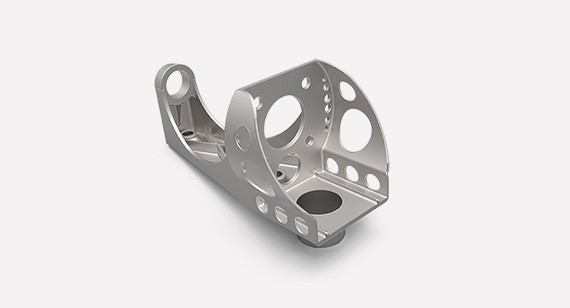
Aluminum. This all-purpose metal used for light-weighting provides excellent strength-to-weight ratio and can be machined or 3D printed.
COMMON AUTOMOTIVE APPLICATIONS
Our digital manufacturing capabilities accelerate the development of a range of metal and plastic automotive components. A few of common automotive applications include:
• Assembly line components
• Fixtures
• Enclosures and housings
• Plastic dash components
• Aftermarket parts
• Armatures
• Lenses and lighting features
• Support for on-board consumer electronics
