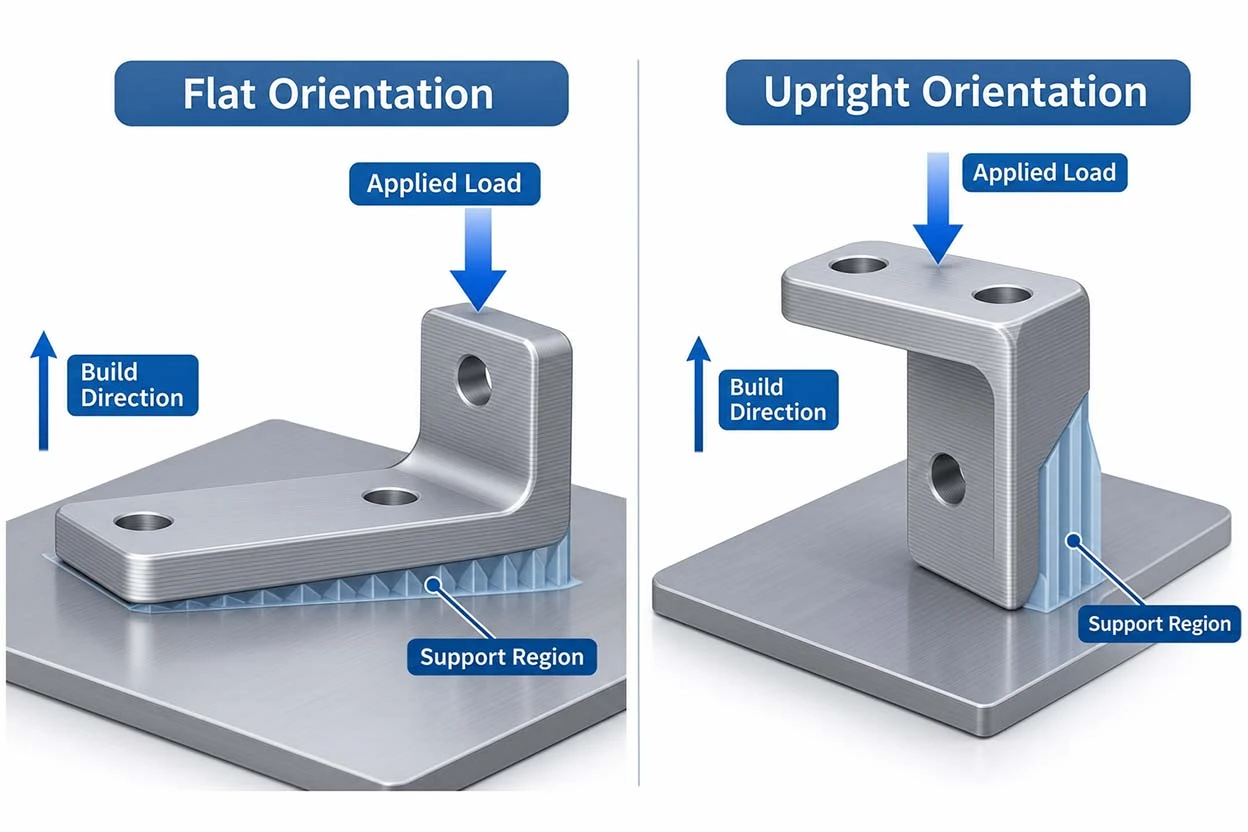
Imagine ordering two identical 3D-printed mounting brackets. One is printed flat on the build platform, while the other stands upright. Both match the same CAD model, but their mechanical behavior, visible layer patterns, and support requirements may differ. This is why 3D printing orientation should be considered before production rather than left entirely to the printer operator. For functional prototypes, the best arrangement is not always the one that prints fastest or uses the least material.
Engineers and buyers should first identify how the component will be loaded, assembled, and inspected.
How 3D Printing Orientation Affects Functional Parts
Consider an L-shaped bracket used to support a small mechanical assembly. If the bracket experiences repeated bending, its build direction may affect how it resists the applied load. In FDM printing, material is deposited in successive layers, and bonding between those layers can be weaker than strength within the printed layer plane. Therefore, 3D printing orientation mechanical properties should be evaluated against the actual loading direction.
However, choosing an orientation based on strength alone can introduce other problems. A position that improves load resistance might require additional supports beneath a mounting flange or create more visible layer steps on an exposed surface. For functional prototype printing orientation, engineers should identify the primary load direction and distinguish structural features from purely cosmetic areas.
Surface Appearance and Assembly Accuracy
Build direction also influences how a printed component looks and fits. A 3D printed part surface finish may vary between upward-facing surfaces, supported regions, and curved features printed across multiple layers. For an electronic enclosure, the outer cover may require a consistent appearance, while its internal mounting points must align accurately with other components.
Changing the orientation to improve the visible surface could affect support placement or the dimensional behavior of those internal features.
Buyers should therefore identify critical mating surfaces, screw holes, reference datums, and cosmetic faces in their drawings. Where necessary, secondary machining or finishing should be discussed before quotation.
Orientation Rules Depend on the Printing Process
Different additive manufacturing technologies respond differently to build orientation. In FDM, layer direction, support placement, and toolpath planning can significantly influence part strength and surface appearance; For SLA, orientation affects support contact locations, surface quality, and the risk of deformation during printing and post-curing; In polymer SLS and MJF, surrounding powder generally supports the part, but orientation can still influence dimensional accuracy, surface texture, cooling behavior, and production layout; For metal powder bed fusion, orientation also affects thermal management, support structures, residual stress, and subsequent machining access.
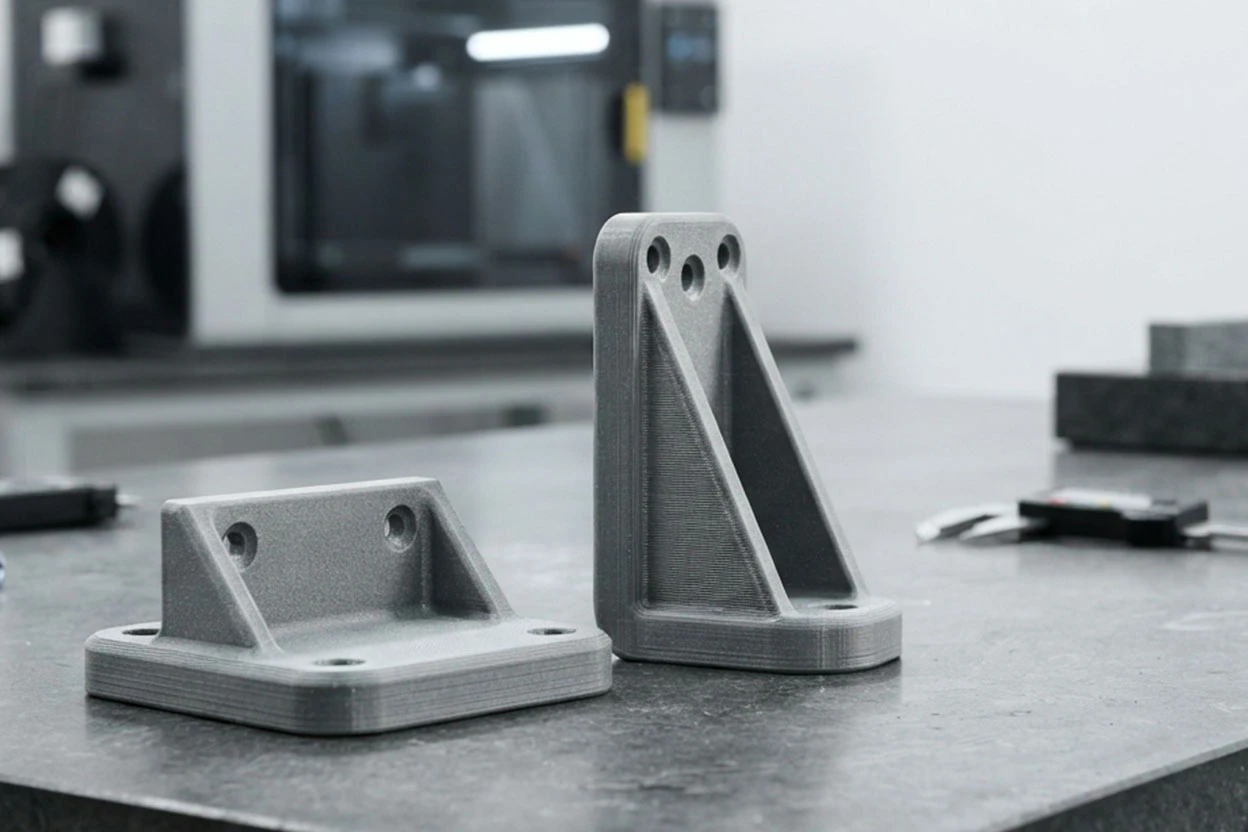
These differences explain why orientation should be reviewed alongside the selected printing material and process instead of specified through one universal rule.
What Should Buyers Mark Before Requesting a Quote?
Clear 3D printing drawing requirements help suppliers evaluate the component's actual function. Before submitting an RFQ, buyers should identify:
-Load direction: Where and how forces act on the component
-Cosmetic surfaces: Faces where support marks or visible layer patterns matter
-Critical dimensions: Mating holes, mounting interfaces, and inspection datums
-Finishing requirements: Areas needing machining, polishing, or other treatment
-Acceptance conditions: Required fit checks, functional tests, or first-piece measurements
A simple annotated CAD screenshot can communicate these requirements more effectively than a model file alone.
Conclusion
3D printing orientation is not merely a production efficiency decision. It connects the intended function of a part with its manufacturing process, mechanical behavior, surface quality, and dimensional requirements. Defining critical features before quotation helps buyers avoid misunderstandings and gives manufacturers a clearer basis for selecting suitable printing conditions.
Custom 3D Printing Projects with SHD Industry
SHD provides custom manufacturing services for prototype development and engineering applications, including plastic and metal 3D printing options. For functional components, SHD welcomes discussions about material selection, build orientation, structural requirements, surface finishing, and dimensional inspection.
Buyers can share CAD files, annotated drawings, and application requirements with SHD to evaluate suitable manufacturing approaches before placing an order.