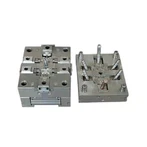
Compared with ordinary die casting, Thixomolding (semi-solid die casting) has the following differences:

· Forming method. Semi-solid die casting maintains the metal melt in a semi-solid state for high-pressure injection molding, while ordinary die casting injects the metal liquid directly into the mold cavity through a nozzle in the mold to form a molded part.
·Molding quality. The internal structure of semi-solid die-casting molded parts is uniform and small, with good centripetal distribution, thus forming high-quality, high-precision castings; although ordinary die-casting parts have good stability in size and shape and low cost, they are The molding quality is usually inferior to semi-solid die casting.
·Pressure control. Semi-solid die-casting requires precise control of heat, heat flow direction and injection speed, so it requires high equipment technology and operating skills; the control method of ordinary die-casting is relatively simple and suitable for mass production.

Product form and scope of application. Semi-solid die-casting is suitable for manufacturing complex parts with high precision, high strength and high toughness, and is especially suitable for high-performance fields such as aerospace and automobile manufacturing. Although ordinary die-casting is more widely used, it is usually not as sophisticated in terms of manufacturing complexity and precision requirements. Semi-solid die casting.
·Production efficiency, cost and energy input. Semi-solid die-casting requires waiting for the metal to be converted into a semi-solid state before processing. The production cycle is long, energy input is high, and manufacturing costs are high. Ordinary die-casting has higher production efficiency, relatively less energy input, and lower costs.
·Mechanical properties and fatigue life. Semi-solid die-cast parts have better mechanical properties and longer fatigue life. This is because the interaction between the metal liquid and the semi-solid metal during the semi-solid casting process makes the structure of the formed parts denser and more uniform; ordinary die-cast parts Parts typically do not perform as well as semi-solid die cast in terms of mechanical properties and fatigue life.