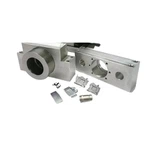
Precision manufacturing challenges often arise when a project moves between CNC machining, mold development, die casting, and vacuum casting. At SHD, we find that each process has its own technical limits, but the greater difficulty is often coordinating them around the same design, tolerance, material, and delivery requirements.
A part that is easy to prototype may not be practical for mass production. Likewise, a geometry suitable for machining may create filling, release, or shrinkage problems when transferred into a mold.
Why Precision Manufacturing Challenges Change With Each Process
The manufacturing route determines which risks must be controlled. CNC machining removes material from a solid block, while molding and die casting depend on material flowing into a cavity. Vacuum casting uses a master model and silicone mold to reproduce a limited quantity of resin parts.
Understanding these differences helps customers select a process based on product needs rather than appearance alone.
CNC Machining Requires Stable References
CNC machining is flexible for prototypes and low-volume components, but accuracy depends on much more than the machine itself.
Fixtures, datum selection, cutting sequence, tool wear, material stress, and temperature can all affect results. Thin walls may deform after material removal, while deep pockets can require long tools that are more likely to vibrate.
At SHD, CNC machining quality control begins with identifying the functional dimensions. Bearing positions, sealing faces, assembly holes, and closely related features normally require greater attention than noncritical exterior surfaces.
Inspection must also follow the machining sequence. Measuring only after every operation is complete may reveal a problem too late for practical correction.
Mold Development Concentrates Risk Early
Mold manufacturing requires decisions that will influence every later production cycle. Parting lines, draft angles, core movement, cooling channels, ejector positions, and surface texture must be planned before steel cutting begins.
A small design issue can become expensive once tooling is completed. For this reason, we review whether the part can be released safely, cooled evenly, and maintained during repeat production.
The challenge is not simply producing the mold. It is building a production tool that can continue operating without unstable dimensions, excessive wear, or difficult maintenance.
Die Casting Must Balance Speed and Stability
Die casting introduces pressure, molten alloy, rapid filling, and repeated heating and cooling. Porosity, incomplete filling, flash, shrinkage, and distortion may result when these factors are not balanced.
Actual production conditions can also change after the mold reaches its normal operating temperature. A first sample may look acceptable, while later castings show dimensional movement or local surface defects.
At SHD, we therefore evaluate process stability together with downstream machining and finishing. Hidden pores may only become visible after a sealing face or threaded hole is machined.
Vacuum Casting Depends on the Master and Mold Condition
Vacuum casting prototypes are useful for design presentation, functional evaluation, and limited production before hard tooling is justified. However, their quality depends heavily on the master model.
Any surface mark or dimensional issue on the master can be transferred into the silicone mold and repeated across later parts. Resin selection, pigment control, curing conditions, wall thickness, and mold aging also influence the result.
Vacuum casting prototypes should therefore be evaluated as production-like samples, but not treated as identical to injection-molded or die-cast components. Their material behavior and dimensional consistency may differ from final mass-production parts.
Coordinating Several Processes in One Project
The most important of all precision manufacturing challenges is choosing where each process belongs.
CNC machining may validate dimensions, vacuum casting may support a small evaluation batch, and mold or die casting development may follow after the design is stable. Moving into tooling too early can increase revision costs, while relying on prototypes for too long may delay scalable production.
SHD reviews geometry, quantity, material, tolerance, finish, and application before recommending a manufacturing route.
Conclusion
Precision manufacturing challenges differ across CNC machining, mold development, die casting, and vacuum casting. Reliable results depend on selecting the right process, controlling its specific risks, and planning how each production stage connects with the next.
Coordinating Your Project From Prototype to Production
At SHD, we address precision manufacturing challenges through design review, CNC machining quality control, mold engineering, die casting support, and vacuum casting prototypes. This coordinated approach helps customers validate new products and prepare them for more stable production.