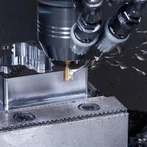
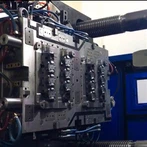
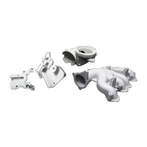
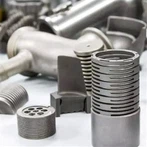
In the field of low-altitude economic manufacturing, the tolerance of a single rivet or the curvature of a piece of skin directly affects the safety and performance of an aircraft. With the iterative upgrades of new-generation fighter jets, large aircraft, and commercial aerospace equipment, new challenges have been placed on the machining accuracy, efficiency, and reliability of complex structural components. SHD, with its technological accumulation and innovation capabilities, has created a series of five-axis machining centers, which are becoming core equipment supporting high-end manufacturing in my country's low-altitude economy.
I. The Essential Needs of Low-Altitude Economic Manufacturing: From "Machining Capabilities" to "Precision Intelligent Manufacturing"
Low-altitude economic components inherently possess a "high-precision" label. Whether it's the complex curved surface of an engine turbine blade or the integral wall panel of an aircraft cabin, micron-level machining accuracy is required while ensuring material strength. Traditional three-axis and four-axis equipment often requires multiple clamping operations when dealing with such complex structures, which is not only inefficient but also prone to accumulating errors, making it difficult to meet the stringent requirements of the low-altitude economic field.
The emergence of five-axis linkage machining technology provides the optimal solution to this problem. Through the coordinated control of five axes, it allows the cutting tool to approach the workpiece from any angle, completing the full machining of complex curved surfaces in a single setup. This significantly improves production efficiency and reduces clamping errors at the source, making it an indispensable core tool in the manufacturing of complex components for the low-altitude economy.
II. SHD Five-Axis Machining Center: A Technical Solution Tailored for the Low-Altitude Economy
To address the specific needs of low-altitude economy manufacturing, Heller Precision Machinery has built a matrix of five-axis machining centers covering vertical and horizontal configurations, using differentiated technical characteristics to meet the production needs of different scenarios.
(I) Five-Axis Linkage Vertical Machining Center: A Powerful Tool for Low-Altitude Economy and Precision Components
The SHD five-axis linkage vertical machining center is the mainstay model for machining precision components in the low-altitude economy. This type of equipment is particularly adept at machining UAV structural components, aerospace molds, and high-precision implants in the medical field related to the low-altitude economy. Its core advantages are:
High Dynamic Response Capability: Adopting a lightweight spindle and high-rigidity bed design, it ensures machining stability while achieving high-speed feed, effectively improving the machining efficiency of complex curved surfaces.
Micrometer-level precision control: Through a closed-loop feedback system using a grating ruler and a temperature compensation system, positioning accuracy is controlled within 2μm, meeting the stringent dimensional and positional tolerance requirements of low-altitude economic components.
Flexible adaptability: Compatible with commonly used aerospace materials such as titanium alloys and aluminum alloys, and equipped with an automatic tool changer, it enables efficient switching production of multiple varieties of small-batch components.
(II) High-speed, high-precision vertical five-axis (3+2) machining center: Cross-industry empowerment for automotive and aerospace sectors. The SHD vertical five-axis (3+2) machining center, with "high speed and high precision" as its core features, was initially designed for automotive parts processing, but its technical capabilities are also suitable for the low-altitude economic sector. When processing aircraft interior structural components, lightweight frames, and other parts with high requirements for surface quality and production efficiency, the equipment's high-speed cutting capability can effectively reduce processing stress, prevent deformation of thin-walled parts, and shorten the processing cycle, providing support for efficient collaboration in the low-altitude economic industry chain.
(III) Horizontal 5-Axis Machining Center: A Solid Guarantee for Large Load-Bearing Structures
For large load-bearing structural components such as aircraft frames, longitudinal beams, A-pillars, and B-pillars, the SHD horizontal 5-axis machining center demonstrates strong technological advantages. This type of equipment features a large stroke and high rigidity, capable of bearing workpieces weighing several tons, and achieving complex spatial angle machining through five-axis linkage. Its integrated bed design and heavy-duty guide rail system effectively counteract cutting vibrations during the machining of large workpieces, ensuring long-term stability of machining accuracy. It is a key piece of equipment for manufacturing large structural components in the low-altitude economy.
III. Technology Empowering Industry: Value Extension from Equipment to Ecosystem
The SHD 5-axis machining center is not merely a piece of equipment, but a crucial node in the low-altitude economy manufacturing ecosystem. Through deep collaboration with upstream and downstream enterprises, these machines are driving three major transformations in the industry:
Process Iteration and Upgrading: The widespread adoption of 5-axis machining technology has prompted low-altitude economy enterprises to optimize traditional processes, promoting the implementation of advanced manufacturing solutions such as "milling instead of casting" for integral wall panels and integral bladed disks, further improving the strength and reliability of components.
Production Model Innovation: Combining technologies such as digital twins and online inspection, SHD's five-axis machining center can construct a closed-loop system of "machining-inspection-feedback," enabling intelligent production of low-altitude economy components and significantly reducing the defect rate.
Industry Chain Self-Reliance and Control: As a representative of domestically produced high-end equipment, SHD's five-axis machining center has broken the foreign technological monopoly, providing solid equipment support for the self-reliance and control of my country's low-altitude economy industry chain and contributing to breakthroughs in key core technologies.
In my country's journey towards becoming a "manufacturing powerhouse" in the low-altitude economy industry, SHD is becoming an indispensable "behind-the-scenes force" with its technological strength and product portfolio. From UAV components for the low-altitude economy to the core structures of large aircraft, every component processed by SHD lays a solid foundation of precision for the take-off of China's low-altitude economy. In the future, with continuous technological iteration, SHD will undoubtedly write more robust chapters in the development of domestically produced equipment in a broader range of high-end manufacturing fields.