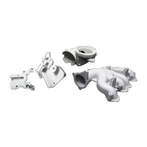
In the current transformation of the manufacturing industry towards high precision, high efficiency, and high flexibility, CNC precision machining has become a key indicator for measuring a company's core competitiveness. As the core equipment in this field, CNC machining centers, with their integrated machining capabilities, superior precision control, and stable production performance, are gradually replacing traditional machining equipment and becoming the "cornerstone of intelligent manufacturing" supporting the development of high-end fields such as aerospace, automotive manufacturing, and medical devices.
CNC Machining Centers: The Core Carrier of CNC Precision Machining
The core requirements of CNC precision machining are "controllable precision, stable efficiency, and the ability to produce complex parts." CNC machining centers, by integrating multi-process machining functions and intelligent control systems, perfectly meet these requirements, becoming an irreplaceable core piece of equipment in this field.
Integrated machining reduces precision loss: Traditional precision machining requires multiple machines operating in separate processes, and repeated workpiece clamping can easily lead to positioning errors. CNC machining centers can complete multiple processes such as milling, drilling, boring, and tapping in one go, reducing the number of clamping operations by more than 80% and effectively controlling machining errors within the range of 0.01-0.05mm, meeting the machining requirements of high-precision parts.
Intelligent control ensures machining stability: The CNC system (such as FANUC or SIEMENS) on the equipment can monitor cutting parameters and tool wear status in real time, and correct machining deviations through automatic compensation functions; combined with high-precision servo motors and ball screws, it achieves precise control of feed speed and position, ensuring the consistency of precision for every product in mass production.
Flexible production adapts to complex needs: Facing the "multi-variety, small-batch" order characteristics of CNC precision machining, CNC machining centers can quickly change tool magazines (tool magazine capacity is usually 24-60 tools) and edit program parameters, completing the machining scenario switch within 10-30 minutes without large-scale equipment adjustments, greatly improving production flexibility.
Technological Breakthroughs in CNC Precision Machining: Centered on CNC Machining Centers
Leveraging the technological advantages of CNC machining centers, CNC precision machining has achieved breakthroughs in three major dimensions: precision, efficiency, and the machining of complex parts, providing key technological support for high-end manufacturing.
Precision Breakthrough: From "Micrometer-Level" to "Sub-Micrometer-Level": Through the high-speed spindles (maximum speed up to 20,000 r/min), constant-temperature workshop environmental control, and online monitoring systems of CNC machining centers, dimensional accuracy of parts can reach ±0.02 mm, and surface roughness Ra≤0.4 μm, meeting the ultra-precision machining requirements of core components such as engine blades and precision bearings in the aerospace field.
Efficiency Improvement: Doubling Capacity per Unit Time: Compared to traditional milling machines, the automatic tool change time of CNC machining centers is reduced to 0.5-2 seconds, and it supports 24-hour continuous unmanned machining. Taking the machining of automotive gearbox housings as an example, the output of traditional equipment is about 50 pieces per shift, while CNC machining centers can increase it to more than 120 pieces, increasing the capacity per unit time by 140%. Complex Part Machining: Breaking Through "Shape Limitations": Multi-axis CNC machining centers (such as five-axis machining centers) can perform multi-angle and multi-directional machining of workpieces, easily handling the machining needs of complex curved surfaces and irregularly shaped parts. For example, in the medical device field, the machining of the curved contours of artificial joints must simultaneously meet precision and biocompatibility requirements. Five-axis CNC machining centers can complete the forming in one pass, increasing the pass rate from 75% with traditional processes to 99%.
Application Areas of CNC Machining Centers and Precision Machining: Covering Core Needs Across Multiple Industries
With their superior machining capabilities, CNC machining centers and CNC precision machining have deeply penetrated multiple high-end manufacturing fields, becoming a key force driving technological upgrades in these industries.
Aerospace Field: Machining core components such as aircraft engine turbine blades and fuselage structural parts requires withstanding high-temperature and high-pressure environments, demanding extremely high dimensional accuracy and material strength. CNC machining centers, using high-strength spindles and carbide cutting tools, can achieve precision cutting of difficult-to-machine materials such as titanium alloys and high-temperature alloys, ensuring stable component performance.
In the automotive manufacturing sector: CNC machining centers can achieve high-efficiency batch processing of precision components such as motor housings and battery trays for new energy vehicles. Simultaneously, online inspection systems can eliminate defective products in real time, ensuring the assembly accuracy and safety of automotive parts.
In the medical device sector: Products such as artificial joints and surgical instruments must meet medical-grade precision standards, with surfaces free of burrs and scratches. CNC machining centers, through integrated low-speed, high-precision cutting and polishing processes, can achieve both surface smoothness and precision, meeting the stringent requirements of medical applications.
In the electronic components sector: The machining accuracy of precision components such as 5G base station filters and semiconductor packaging molds directly affects product performance. CNC machining centers, through micro-milling technology, can achieve precise machining of micro-holes (0.1-0.5mm in diameter) and narrow slits (0.05-0.1mm in width), supporting the miniaturization and high-precision development needs of the electronics industry.
Choosing Professional CNC Machining Center Services: Empowering Enterprises to Upgrade Precision Manufacturing
For businesses, selecting a suitable CNC machining center and professional CNC precision machining services is key to enhancing product competitiveness and reducing costs while increasing efficiency. When choosing a partner, three core elements should be emphasized:
Equipment Configuration and Technical Strength: Prioritize service providers equipped with mainstream CNC systems and high-precision testing equipment (such as coordinate measuring machines) to ensure machining accuracy and stability. Also, consider the service provider's technical team, ensuring they possess the capability for complex part programming and process optimization.
Quality Control System: A robust quality control system is essential for precision machining. Verify whether the service provider has obtained ISO9001, IATF16949, or other quality management system certifications, and whether they have established a comprehensive control mechanism from raw material inspection and processing monitoring to finished product inspection.
Customized Service Capabilities: Different industries have varying processing needs. Service providers must have the ability to optimize processing techniques and adjust equipment parameters based on the enterprise's product characteristics. For example, they should provide customized fixture designs for irregularly shaped parts and develop flexible production solutions for bulk orders.
In the wave of rapid development of high-end manufacturing industries, CNC machining centers are no longer simply processing equipment, but rather a core engine driving technological innovation in CNC precision machining and helping enterprises achieve "intelligent manufacturing upgrades." In the future, with the deep integration of 5G, artificial intelligence, and CNC machining technologies, CNC machining centers will develop towards "higher precision, greater intelligence, and greener standards," continuously injecting new momentum into the high-quality development of the manufacturing industry.